


Online Motor Parts Store: What to Look For Before You Buy an Engine

An online motor parts store should make one thing simple: finding an engine that actually fits your vehicle, comes tested, and ships without three weeks of back-and-forth emails. That’s really the whole point of buying this way instead of driving around to five different salvage yards. If you’ve spent any time searching for a replacement motor lately, you already know how much noise is out there — listings with no specs, sellers who won’t pick up the phone, prices that jump the second you mention shipping. We built our catalog to cut through that, and we sell the engines directly, not just ads pointing you somewhere else.
We’re not a directory. We’re an online motor parts store that actually holds inventory — used engines, reconditioned engines, and a smaller line of new units — and every listing on our site is something you can order today, not a placeholder waiting on a supplier to confirm it exists. That distinction matters more than most buyers realize until they’ve been burned by the other kind of site.
Why buying from an online motor parts store beats the local hunt
Twenty years ago, replacing an engine meant calling every yard within driving distance, hoping someone had your exact application, and taking their word for the mileage and condition. That approach still works occasionally, but it’s slow and it puts all the risk on you. An online motor parts store with a real inventory system flips that. You can filter by engine code, see the price up front, read the actual specs, and place the order the same day you found the listing.
It also opens up supply that simply doesn’t exist locally. A shop in a cold-weather state might have plenty of domestic V8s sitting around but nothing for a Japanese import with 60,000 miles on it. We carry both, along with turbocharged diesel units and a few transmissions, because a national and international catalog can hold that kind of range in a way one regional yard never could.
There’s also a pricing transparency angle that gets overlooked. A local yard often prices by feel — what they think you’ll pay, adjusted by how busy they are that week. An online motor parts store running on a real catalog has to price consistently, because every customer can see every listing and compare. That competitive pressure keeps pricing honest in a way a single phone call to one yard never will.
What’s actually in stock
Every engine we list gets a real spec sheet, not a vague “runs good” description. Here’s a sample of what’s currently moving through the shop, pulled straight from live inventory:
| Engine | Type | Approx. Price (USD) | Typical Application |
|---|---|---|---|
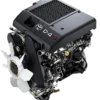
| Toyota J05E | 4-cyl turbo diesel, 5.1L | $4,950 | Dyna trucks, buses, industrial |
| Mazda Skyactiv-G 2.0L | Inline-4, gasoline | $1,600 | Mazda3, Mazda6, CX-5 |
| BMW N55B30T0 | Inline-6 turbo | $2,900 | 335i, 535i, X5 |
| Nissan VQ37VHR | V6, 3.7L | $2,400 | 370Z, G37, FX37 |
| Mitsubishi 6B31 | V6, 3.0L | $1,800 | Outlander, Pajero |
| Ford 4R70W | Automatic transmission | $900 | Mustang, F-150, Crown Victoria |
That table changes weekly as engines sell and new ones come in from teardown, so treat prices as a snapshot rather than a permanent quote. What doesn’t change is the process behind each listing: pull, inspect, grade, price, publish. Nothing goes live until someone’s physically looked at it.
New, used, and reconditioned — what the difference actually means
People throw these terms around loosely, so it’s worth being precise about what you’re buying from an online motor parts store like ours.
Used engines come out of a donor vehicle, usually after an accident, a transmission failure, or a total loss where the motor itself was undamaged. We compression test, leak-down test, and visually inspect the block, heads, and accessories before it’s listed. Mileage is disclosed, not estimated.
Reconditioned engines have gone further — new gaskets, seals, and wear items are replaced, and the unit is bench-run before it ships. You pay more than a straight used pull, but you’re getting fewer unknowns.
New engines are the smallest slice of what we carry, mostly for applications where a factory-fresh crate unit makes more sense than a used or reconditioned option — fleet vehicles, for instance, where downtime costs more than the price difference.
How pricing actually works
Prices on an online motor parts store aren’t pulled out of thin air, and if you’ve ever wondered why the same engine code can list for $1,600 in one place and $2,800 in another, it usually comes down to a handful of factors. Mileage is the biggest one — an engine pulled from a car with 45,000 miles is worth more than the same code pulled from one with 130,000, even if both test fine today. Condition grade matters too. We sort inventory roughly into tiers: standard used, low-mileage or “select” grade, and reconditioned. A standard used unit that passed compression and leak-down testing sits at the base price. Low-mileage units carry a premium because there’s simply more service life left in them. Reconditioned units cost more still, because labor and replacement parts went into them before they ever hit the listing page.
Rarity plays a role as well. A common domestic V8 that gets pulled from hundreds of donor vehicles a year is going to be priced lower than a low-volume import engine that’s harder to source in the first place. And accessories matter — whether the engine comes bare, or with the wiring harness, ECU, turbo, and intake still attached changes both the price and how much work you’ll have on install day. Every listing on our site spells out exactly what’s included, because “engine only” and “complete engine” are two very different purchases and the price should reflect that clearly, not get buried in fine print.
Common mistakes buyers make when shopping an online motor parts store
We see the same handful of mistakes repeat themselves, and most of them are avoidable with a little patience. The first is buying on price alone without checking what’s actually included — an engine listed $400 cheaper than everywhere else is sometimes just missing the harness and sensors you’ll need to buy separately, which erases the savings fast. The second is skipping the VIN check. Engine codes can share a name across multiple displacement or emissions variants, and a mismatch means a motor that bolts in but never runs right. The third is ignoring the warranty terms until after something goes wrong — read them before you buy, not after.
The fourth mistake is underestimating shipping timelines, especially for international orders. Ocean freight isn’t fast, and a buyer who orders an engine two days before a scheduled repair is setting themselves up for a bad week. Build in a buffer. The fifth, and maybe the most common, is not asking questions before ordering. A legitimate online motor parts store wants those questions — it’s the fly-by-night sellers who go quiet when you start asking about test results and return policy.
How an online motor parts store actually tests an engine
This is the part most listings skip, and it’s the part that matters most. Before anything from our inventory goes up for sale, it goes through a standard set of checks: compression across all cylinders, a leak-down test to catch ring or valve issues a compression test alone might miss, a visual inspection of the block and heads for cracks or warping, and a check of the wiring harness and sensors where applicable. Diesel units get an additional look at the fuel injection system, since that’s a common failure point on high-mileage units.
None of this guarantees an engine will never need attention — nothing used ever comes with that guarantee, and any seller who promises it is overselling. What it does mean is you’re not buying blind. You know the compression numbers, you know the mileage, and you know it ran before it shipped.
Shipping from an online motor parts store, worldwide
We ship domestically by freight and internationally by ocean container, and we’ve sent engines to buyers on every populated continent. Engines are drained of fluids, secured to a pallet or crated depending on size, and covered by a Certificate of Origin along with the export paperwork your customs broker will need. Freight cost depends heavily on destination port and engine weight, so we quote it per order rather than posting a flat number that would be wrong for most buyers.
If you’re a shop owner or fleet operator ordering more than one unit, it’s worth asking about consolidated shipping — combining multiple engines into a single container cuts the per-unit freight cost noticeably, which matters if you’re restocking rather than buying once.
Warranty and what happens if something’s wrong
Every engine ships with a written warranty period, typically 30 to 90 days depending on the unit and condition grade, covering internal mechanical failure. It doesn’t cover installation errors, electrical issues unrelated to the engine itself, or damage from running it without oil or coolant — that’s on whoever does the install. If a covered issue shows up, you contact us with the order number and a description of the problem, and we work through it from there. We’d rather deal with an occasional warranty claim honestly than pretend every used engine is flawless, because it isn’t, and buyers who’ve bought engines before already know that.
How to actually order
Ordering from an online motor parts store should be a short process, and here’s how it works on our end:
- Find your engine by model, engine code, or vehicle application — if you’re not sure of the code, your VIN can confirm it.
- Check the listed specs and mileage, and message us if you need a photo of the specific unit rather than a stock image.
- Place the order and provide your shipping address, including port information if you’re ordering internationally.
- We pull, re-test, and prep the specific unit assigned to your order before it ships.
- You receive tracking information and, for exports, the accompanying documentation.
Most domestic orders leave the warehouse within 3 to 5 business days. International orders take longer, mostly due to vessel schedules rather than anything on our end.
Buying used versus buying new from a dealer
A dealer quote for a brand-new engine on most mainstream vehicles lands somewhere between three and ten times what a tested used unit costs through an online motor parts store, and that gap only gets wider on older or less common models where the manufacturer has started treating replacement engines as a low-volume, high-margin part. Labor to install is roughly the same either way, so the difference in total repair cost comes almost entirely from the parts price. For a vehicle that’s still got years of useful life left in the body, suspension, and interior, paying dealer prices for the engine alone rarely makes financial sense.
The counterargument dealers make is warranty length, and it’s fair — a new crate engine usually carries a longer warranty than a used one. But a used engine with documented mileage and test results, backed by a real warranty period and a seller who’ll actually answer the phone if something goes wrong, closes most of that gap. For the price difference involved, it’s worth it for the overwhelming majority of buyers.
Buying globally, not just locally
Because we operate as an online motor parts store rather than a single physical counter, our buyers aren’t confined to one region. Orders go out across North America, Europe, the Middle East, Asia, and beyond, and the process is the same regardless of destination: confirm the application, test the unit, prepare export documentation, and ship. Import duties and local compliance requirements vary by country, and that part is on the buyer or their customs broker to sort out, but the sourcing and testing side stays consistent no matter where the engine is headed. If your market has specific import restrictions on engine age or emissions rating, let us know before you order — it’s a lot easier to check compatibility up front than to deal with a held shipment at customs.
Who actually buys from us
The mix is wider than people expect. Independent mechanics restocking for customer jobs. Individual owners who got a quote from a dealer and decided a new engine wasn’t worth it. Fleet managers replacing a motor in a work truck that can’t sit idle for a month. Exporters buying in volume to resell in markets where new engines are taxed heavily or hard to source. If you want a deeper look at how that export side works, we’ve written about it separately in our engine sourcing coverage.
What all of them have in common is that they want a straight answer about condition and price, not a sales pitch. That’s the standard we try to hold every listing to.
There’s a practical environmental angle too
It’s not the main reason most people buy from an online motor parts store, but it’s worth mentioning. Manufacturing a new engine block from raw metal is resource-intensive — mining, smelting, casting, machining, all before the first bolt goes in. Reusing a functional engine that already exists, testing it properly, and putting it back into service skips almost all of that. It’s the same logic that makes rebuilding worthwhile instead of scrapping a mechanically sound motor just because the vehicle it originally came from was totaled for unrelated reasons. Buyers don’t need to frame the decision around sustainability to benefit from it, but it’s a real side effect of an industry that’s ultimately about keeping working parts working rather than sending them to a shredder.
A few things worth checking before you buy from any online motor parts store
Even with us, or with any seller, a few questions are worth asking every time: Is the mileage actual or estimated? Was the engine tested before or only after the sale? What exactly does the warranty cover, and for how long? Is the price quoted the full landed cost, or does freight get added later as a surprise? A seller who answers all four clearly and quickly is usually one worth doing business with. One who dodges any of them is worth walking away from, regardless of how good the price looks.
We’ve put together more detail on related topics if you want to go deeper — our notes on used auto parts and engines cover how we handle parts beyond just engines, and our piece on running a consistent engine supply operation gets into how we keep inventory predictable for repeat buyers like shops and fleets.
Frequently asked questions
Do you sell individual parts, or only complete engines?
Both. Complete engines are the core of the catalog, but we also move transmissions, and we can often source individual components — heads, turbos, wiring harnesses — for buyers who only need a piece rather than the whole unit.
Can I get a photo of the exact engine before I pay?
Yes, and we’d recommend asking for one if the listing only shows a stock or representative image. It only takes a day or two to send current photos of the specific unit tied to your order.
What if the engine I need isn’t listed?
Message us with the year, make, model, and engine code. Inventory turns over constantly, and we can frequently source a specific application within a few business days even if it’s not on the site yet.
Do you offer local pickup, or is everything shipped?
Most orders ship, since the buyer base is national and international rather than local. Pickup is possible in limited cases — ask before you order if that’s what you need.
How do returns work if the engine doesn’t fit?
Fitment issues are rare when the VIN or engine code was confirmed up front, which is why we push buyers to verify before ordering. If a genuine mismatch happens on our end, we work out a return or exchange rather than leaving you stuck with a motor you can’t use.
The bottom line
An online motor parts store is only as good as what happens before the listing goes live — the testing, the honest grading, the accurate specs. Anyone can put a photo and a price on a page. Standing behind what’s actually in the crate when it arrives is the part that’s harder to fake, and it’s the part we’d rather be judged on. Browse the current inventory, check the specs against your vehicle, and reach out if you don’t see your application listed yet — we add new units every week and can often source something specific within a few days.
Posts Widget




Best Auto Motors
USA HERALD MAGAZINE INC
Buy the best quality engines from our website online and get a fast delivery within 6 days.
Copyright 2022.KlbTheme . All rights reserved
