


Used Engines for Toyota Corolla: 1ZZ-FE, 2AZ-FE & ZR-Series Specs, Pricing, and Buying Guide

A Corolla with a dead engine still doesn’t deserve to be scrapped — this is one of the most reliable, most repairable cars ever built, and in most cases the smartest move isn’t replacing the whole car, it’s replacing the engine and getting another decade out of it. That’s exactly what we’re here for. We stock used engines for Toyota Corolla pulled from real donor cars, tested before they ship, priced so the math actually makes sense compared to car shopping.
The Corolla has run on a handful of different four-cylinder engine families across its many generations, and while these are some of the most dependable engines Toyota has ever built, they’re not immune to failure — timing chain and belt issues, oil consumption problems on certain generations, and plain old high-mileage wear all eventually catch up with even the toughest little four-cylinder.
We hear from Corolla owners in every situation — commuters whose 200,000-mile car finally needs some real attention, parents handing a car down to a teenager who want it mechanically sound first, rideshare drivers whose income depends on keeping a reliable car on the road. Whatever brought you here, sourcing genuine used engines for Toyota Corolla applications is almost always the more sensible path than starting over with a different vehicle.
Signs Your Corolla Needs a Replacement Engine
Corolla owners usually don’t plan on buying an engine — it’s a gradual thing. A knock that started small and got louder, a check engine light a shop couldn’t clear, or a car that finally wouldn’t restart after weeks of hesitant starting. A few patterns show up again and again on these cars.
On the older 1ZZ-FE engines (late 1990s through mid-2000s), excessive oil consumption is a well-documented issue tied to piston ring design — some owners find themselves adding a quart every thousand miles or less, and if that goes unnoticed long enough, the engine eventually runs low enough to cause bearing damage. On the 2AZ-FE (found in the Corolla’s larger-engine trims and shared with the Camry), oil consumption issues also showed up on certain production years, alongside occasional head gasket problems on higher-mileage examples. On the newer 2ZR-FE and 2ZR-FAE engines, timing chain stretch on very high-mileage cars and, less commonly, VVT-i actuator issues can cause a rattling noise on startup that gradually gets worse.
White smoke with a sweet smell usually means coolant is getting into the combustion chamber — a head gasket issue that’s more common on higher-mileage 2AZ-FE cars specifically. A knock that’s louder under load and doesn’t go away as the engine warms up usually means the bottom end has taken real damage, and at that point, replacement is almost always more sensible than a rebuild given how affordable used Corolla engines are.
Which Engine Is In Your Corolla?
The 1ZZ-FE, a 1.8L inline-four, powered Corollas from roughly 1998 through 2008, producing around 125-130 horsepower — modest, but paired with the Corolla’s light weight, it made for a genuinely efficient, easy-to-live-with car. This engine is chain-driven and mechanically simple, which is part of why it has such a strong reputation for longevity when the oil consumption issue is managed properly.
The 2AZ-FE, a 2.4L inline-four, was used in certain higher-trim Corollas (and much more widely in the Camry and other Toyota models) roughly from 2003 through 2008, producing around 158 horsepower. It’s a chain-driven engine as well, and you can find more background on the broader Toyota AZ engine family if you’re curious how widely it was used across the lineup.
Starting around 2007-2008 and continuing through most of the 2010s, Toyota introduced the 1ZR-FE and 2ZR-FE engines (1.8L and later a 1.8L with Valvematic in some markets), moving to a more modern design with better fuel economy. From around 2019 onward, the current-generation Corolla uses the 2ZR-FAE (1.8L hybrid-compatible) or the M20A-FKS 2.0L Dynamic Force engine in the higher-output trims, both representing a further step up in efficiency and refinement.
1ZZ-FE 1.8L Specifications
- Configuration: Inline-4, DOHC, 16-valve
- Displacement: 1,794cc (1.8L)
- Horsepower: approximately 125-130 hp
- Torque: approximately 122-125 lb-ft
- Valvetrain: VVT-i
- Timing: Chain-driven
- Used in: Corolla, Celica, MR2 Spyder, Matrix
2AZ-FE 2.4L Specifications
- Configuration: Inline-4, DOHC, 16-valve
- Displacement: 2,362cc (2.4L)
- Horsepower: approximately 158 hp
- Torque: approximately 162 lb-ft
- Valvetrain: VVT-i
- Timing: Chain-driven
- Used in: Corolla, Camry, RAV4, Highlander, Scion tC
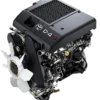
We currently stock a tested 2AZ-FE engine — check the listing for verified mileage and current pricing on this widely-used four-cylinder.
1.8L ZR-Series and 2.0L Dynamic Force Specifications (Later Generations)
- Configuration: Inline-4, DOHC, 16-valve
- Displacement: 1,798cc (1.8L ZR-series) or 1,987cc (2.0L Dynamic Force)
- Horsepower: approximately 132-140 hp (1.8L) or 169 hp (2.0L)
- Torque: approximately 128 lb-ft (1.8L) or 151 lb-ft (2.0L)
- Valvetrain: Dual VVT-i, some with Valvematic
- Fuel System: Port injection (early ZR-series) or direct injection (Dynamic Force)
- Timing: Chain-driven
- Used in: Corolla, Corolla Hatchback, Prius (hybrid variant), Matrix
These later engines represent a meaningful step forward in reliability and fuel economy over the earlier 1ZZ-FE, and while they’re newer to the used market, they’re becoming more available as higher-mileage examples and accident-damaged donor cars come through auction and salvage channels.
What Makes Corolla Engines Different From Performance Applications
Unlike some of the higher-output vehicles we work with, Corolla engines are built for longevity and efficiency rather than outright power, and that shows in how they fail — gradual wear and known maintenance issues rather than sudden catastrophic damage from aggressive driving. That’s actually good news for used engine buyers: the failure patterns are well understood, predictable, and easy to inspect for, which is part of why we’re comfortable standing behind every unit that passes our compression and visual inspection process.
Corolla Engines by Generation
| Model Years | Generation | Engine | Notes |
|---|---|---|---|
| 1998-2008 | 9th-10th Gen | 1ZZ-FE 1.8L | Known oil consumption issue on some years |
| 2003-2008 | 9th-10th Gen (select trims) | 2AZ-FE 2.4L | Shared with Camry, RAV4 |
| 2009-2018 | 11th-12th Gen | 1ZR-FE / 2ZR-FE 1.8L | More modern design, chain-driven |
| 2019-present | 13th Gen | 2ZR-FAE 1.8L / M20A-FKS 2.0L | Direct injection, hybrid-compatible variant available |
Because Toyota shared its four-cylinder engines so widely across the lineup, sourcing used engines for Toyota Corolla applications sometimes means widening your search to a Camry, RAV4, or Matrix donor with the matching engine code — the core architecture is often identical even when accessory brackets or oil pan shapes differ slightly. Always confirm the exact engine code against your Corolla’s VIN before ordering.
Why Corolla Owners End Up Replacing an Engine
On the 1ZZ-FE cars, oil consumption is far and away the most common underlying cause of eventual engine failure. It’s a documented issue tied to piston ring design on this specific engine, and it’s manageable with vigilant oil level checks, but plenty of owners don’t realize how much oil their car is using until the damage is already done. On the 2AZ-FE, head gasket failure on higher-mileage examples is a recurring theme, sometimes compounded by oil consumption issues as well.
On the newer ZR-series engines, we see fewer catastrophic failures and more straightforward high-mileage wear — timing chain stretch, worn piston rings, and the occasional VVT-i actuator problem causing a rattle on cold start. Across all generations, overheating from a neglected cooling system remains one of the more preventable causes of engine failure we see, and it’s a shame every time, since a $30 thermostat or a $150 water pump could have prevented a $2,000+ engine replacement.
What We Check Before Listing a Used Corolla Engine
Every engine gets a compression test across all four cylinders before it’s cleared for sale. We check specifically for signs of oil consumption issues on 1ZZ-FE and 2AZ-FE units given how common this problem is on the platform, inspect for coolant intrusion into the oil, and look over the block and heads for cracks or damage. We record mileage from the donor vehicle whenever it’s verifiable and note anything relevant to the engine’s condition.
If an engine doesn’t pass inspection, it doesn’t get listed as a running unit — it gets parted out instead.
Why Buy Your Used Corolla Engine From Us
There’s no shortage of places claiming to sell used engines for Toyota Corolla owners, and from a listing photo alone they mostly look identical. Here’s what actually matters to us: every engine gets compression tested before it’s listed, not after a complaint comes in. We photograph the specific unit you’ll receive, not a stock catalog image. We document mileage whenever the donor’s history makes that possible, and we’re upfront when it doesn’t. And when you call about fitment across the many Corolla generations, you’re talking to someone who’s actually handled the specific engine code you’re asking about.
Corolla engines are some of our most frequently requested units given how many of these cars are on the road — inventory turns over regularly, so if something matches your VIN and budget, it’s worth acting on rather than waiting.
New, Remanufactured, or Used
A new long block through Toyota is available but expensive relative to the car’s overall value — for a Corolla specifically, spending five figures on a new crate engine rarely makes financial sense given what these cars are worth on the used market. Remanufactured units cost less but still represent a significant chunk of the car’s value. A tested used engine, by contrast, is almost always the most sensible path for a Corolla, since it keeps the total repair cost proportional to what the car is actually worth.
What It Actually Costs
Corollas are, refreshingly, one of the more affordable vehicles to source a replacement engine for, simply because so many were built and the used parts market is deep. A tested used used engine for Toyota Corolla applications typically costs a fraction of what a new or remanufactured unit runs, and given the car’s overall value, that’s exactly the math that makes an engine swap worthwhile instead of buying a different car entirely. Labor for a four-cylinder swap is also comparatively straightforward and affordable compared to V6 or V8 platforms, which helps the overall economics even more.
Buying Used vs. Buying a Different Car
Given how affordable Corolla engines and their installation tend to be, replacing the engine is very often cheaper than buying a comparable replacement vehicle — especially once you factor in sales tax, registration, and a new insurance rate on a different car. If the rest of your Corolla is in decent shape — body, transmission, interior — a used engine swap is usually the more economical path by a wide margin. Where that calculation changes is if you’re facing a stack of other repairs beyond just the engine; in that case, it’s worth having an honest conversation with your mechanic about the car’s overall condition first.
What to Confirm Before You Order
Match your exact engine code and generation to your VIN, not just the model year — Corolla trims sometimes offered different engine options within the same model year. Ask whether the listing includes the wiring harness and ECU or just the long block, since older Corolla ECUs can be picky about matching exactly. Confirm what accessories are included — intake manifold, alternator, and so on — so there are no surprises when the engine arrives.
We list engine code, verified mileage where available, included components, and photos of the actual unit on every product page.
Shipping and Installation
We ship Corolla engines worldwide, crated for freight transport with mating surfaces protected. Given how compact and light these four-cylinder engines are compared to V6 and V8 units, shipping costs are typically lower too — one more way the overall economics favor a used engine swap on this car.
Installation on any Corolla four-cylinder is routine work for the vast majority of general repair shops, given how common these engines are. Budget for fresh engine mounts, a full gasket set, and new fluids as standard practice regardless of what the seller says about the engine’s current condition.
Corolla Engines and Rideshare or Delivery Use
A meaningful share of Corolla owners use these cars for rideshare driving or delivery work, which means far higher annual mileage than a typical commuter car and, correspondingly, more owners hitting engine issues sooner in the car’s lifespan. If that’s your situation, it’s worth thinking about total cost of ownership a bit differently — a tested used engine that gets you another 100,000-150,000 miles is often a better return on investment than either an expensive repair on the original engine or the depreciation hit of buying a different vehicle while your rating and account history stay with the car you already know. We’re happy to talk through options if you’re weighing a swap against a replacement vehicle for exactly this kind of use case.
A Note on Hybrid Corolla Engines
If your Corolla is a hybrid variant, be aware that the gasoline engine works in tandem with an electric motor and battery pack, and a used gasoline engine swap on a hybrid model is a more specialized job than on a standard gasoline Corolla. The engine itself can often be sourced and replaced similarly to a non-hybrid unit, but integration with the hybrid system requires a shop with specific Toyota hybrid experience. If you’re driving a hybrid Corolla and need an engine, let us know when you reach out so we can help confirm the right match.
Frequently Asked Questions
Will a Matrix or Camry engine fit my Corolla?
Often, yes, since Toyota shared these engine families widely, but always confirm the exact engine code against your Corolla’s VIN before ordering — accessory configurations can differ between applications.
How do I know if my Corolla has the oil consumption issue?
Check your oil level regularly between changes. If you’re adding a quart or more between standard oil change intervals, that’s a sign worth having a mechanic investigate, particularly on 1ZZ-FE and 2AZ-FE engines.
How many miles are typical on a used Corolla engine?
It depends on current stock. We document verified mileage whenever the donor vehicle’s history allows it and are upfront when we can’t confirm exact figures.
Do you ship internationally?
Yes, we ship used Corolla engines worldwide. Customs duties and import documentation are the buyer’s responsibility, but we provide any paperwork needed on our end.
Does a used engine come with a warranty?
Yes, our used engines include a warranty period. Terms can vary by engine family and mileage, so check the specific product page or ask our team for current details.
What’s included with the engine listing?
This varies by listing — some are complete long blocks with accessories, others are bare. Check the specific product page or ask before ordering.
Get Your Corolla Back on the Road
Whatever generation of Corolla you’re driving, a tested used engine is almost always the smartest, most affordable way to keep it running for years to come. Check out our current 2AZ-FE engine listing, browse our full used engine inventory, or reach out if you need help matching your VIN to the right unit.
Shopping for a different vehicle? Check out our guides for used engines for Infiniti Q50, used engines for Acura MDX, used engines for GMC Sierra, and used engines for Chrysler 300.
Posts Widget




Best Auto Motors
USA HERALD MAGAZINE INC
Buy the best quality engines from our website online and get a fast delivery within 6 days.
Copyright 2022.KlbTheme . All rights reserved
